It’s important to evaluate mission when deciding which aircraft to own. In my case, I earned my PPL in a Citabria (Feb 2018 – June 2019) and I have owned one since Oct 2019. It’s great fun – tailwheel, tandem, aerobatic, and good climb performance – but limited capacity, VFR-only, passenger view is lacking, and the speed/range does not suffice for long-distance travel.
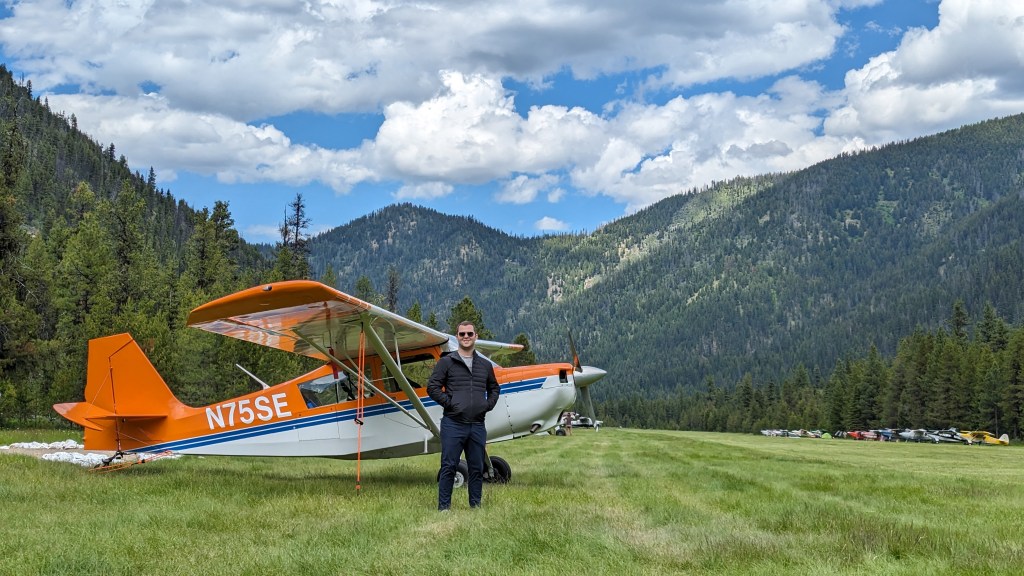
Now that I have a family of three (wife, toddler, and me), it’s time to consider something different. I don’t fly aerobatics much and I expect more long-distance travel in our future, especially after our son is elementary-school age. Below is a high-level view of my evaluation:
Useful load, seats, and comfort
Citabria has 2 seats and ~550 lb useful load. Having a toddler means that we need 4 seats or better. Club seating for 6 in total (as in a Bonanza) would be nice but it’s not required. I’d like to be able to carry four “full-size” adults if possible, so we have the option to bring adult family and friends on regional trips too. For example, carrying my parents non-stop between NorCal and Las Vegas is a likely scenario.
On the comfort side, California gets hot in summer afternoons, so air-conditioning would be a plus. Although I’m not that tall, I’m proportionally all torso and hit my head in some airplanes. It would be nice to stretch out on long trips too.
Require: 4+ seats, ~1000 lb useful load, head and shoulder room
Prefer: Air conditioning
Speed and range
Citabria cruises ~120 mph. I’ve flown it from NorCal to Wisconsin twice so far, which takes maybe 2.5 days, weather permitting, with stops every ~350 miles. It would be nice to do that in one long, single day. Reducing the number of fuel stops can save a lot of time too (maybe ~30 min per stop).
Additionally, enough range for non-stop trips from NorCal to Seattle, Portland, Las Vegas, and Phoenix would be helpful. Bonus points if coast-to-coast trips become a reasonable choice over commercial flights, possibly to visit my in-laws in Georgia for holidays or other occasions.
Require: 750+ sm range before IFR reserves, 150+ mph cruise
Prefer: 1000+ sm range, 180+ mph cruise
IFR capability
Marine layers are a daily occurrence in NorCal during the summer. In my Citabria, I often need to wait for the sky to clear before going anywhere. Being able to pop through a layer or, better yet, improve suitability for long-distance travel by having a fully IFR-equipped aircraft would improve usability. FIKI is not necessary. Oxygen would be a plus for crossing mountains but I have very limited experience with it in practice.
Require: IFR equipped with glass panel and autopilot
Prefer: Garmin avionics, installed oxygen
Climb rate at altitude
I love mountain flying. Taking my airplane to Tahoe (KTVL) for lunch is a great way to spend a summer afternoon. Johnson Creek (3U2) was one of the most memorable airports I’ve visited. Mountain flying during the Alaska Float Rating experience was amazing. I’ve enjoyed stopping at Sedona (KSEZ) and Flagstaff (KFLG) on my way through the Southwest. Colorado flying at Leadville (KLXV), Aspen (KASE), and Telluride (KTEX) has been on my bucket list.
The airplane needs to capable of getting into these places and climbing safely back out at high density altitude, preferably when loaded at gross weight.
Require: 500+ fpm climb at 10,000’ density altitude
Prefer: 1000+ fpm climb rate
Maintenance
The process of maintaining a certified aircraft sucks, even when it’s in good condition (as is the case with the Citabria). In my experience, shops don’t really need private GA owners’ business and it feels like they are doing a favor when they agree to do an annual, and then you pay them $210/hr for labor plus expensive, certified parts. Backordered parts are also a huge issue that seems to affect certified aircraft more.
Experimental aircraft make owner maintenance more possible (especially because of MOSAIC), meaning that working with a shop becomes optional if you build the plane or take a class.
Prefer: Experimental
Insurance
Insurance rates are a noteworthy, long-term, fixed expense. Complex landing gear, taildraggers, and unproven airplanes all make it cost more… sometimes a lot more.
Prefer: Reasonable rates (more likely with fixed gear, nosewheel, and proven types)
Build time
Although MOSAIC expands the definition of “light-sport” and will allow kit manufacturers to factory-build more aircraft, most kit aircraft are still likely to be built in private garages and hangars. Of course, it’s possible to buy used certified aircraft or used experimental to avoid the hassle, but I think building would be highly rewarding in itself. For builders, pull rivet construction and build assist can really speed things up over traditional solid rivet construction.
Prefer: Pull rivet construction, possibly build assist if going experimental
Contenders
To summarize, the most suitable airplane is IFR-equipped with enough capacity to move the family and our stuff in comfort, with speed, over a good range, and at a reasonable cost to own. After extensive consideration, here were the top options:
- Cessna T182 / T182T
- Pros: Reasonable cruise, long range, heavy hauler, high wing, Textron support, reasonable insurance
- Cons: Handles like a truck, boring, certified maintenance
- G36 Bonanza
- Pros: Iconic aircraft, great cross-country machine, club seating for 6, comfortable
- Cons: Expensive to buy/own, recently out of production, long TO/LDG roll
- Cirrus SR22 / SR22T
- Pros: Very modern, fast, great range, build quality, parachute
- Cons: Very expensive to buy/own, fast depreciation, hit my head on ceiling, long TO/LDG roll
- Sling TSi / HW
- Pros: Modern kit aircraft, turbo Rotax maintains power at altitude, fuel efficient, great range, pull rivet construction, taildragger available, parachute option, high wing available, factory build assist available
- Cons: Climb rate could be better, TSi cabin is too tight, doesn’t feel as “solid,” expensive to insure, less proven than Van’s, relatively lighter wing loading, acquisition cost about the same as more capable RV-10
- RV-10
- Pros: fast, comfortable, stable, strong builder/aftermarket support, HQ nearby, reasonable insurance, maintainability, proven aircraft type
- Cons: less range than some others, long build time
I have flown all of these airplanes except the Bonanza, which wasn’t necessary because I was able to make up my mind without the test flight. There is no wrong answer here, but ultimately I decided that the Van’s RV-10 works best due to its balance of high performance, comfort, maintainability, insurability, and support. The main downside is that it takes a long time to build.
It will be a long build journey ahead, but I’m excited to get started.
Winner: RV-10
 Adam's site
Leave a comment